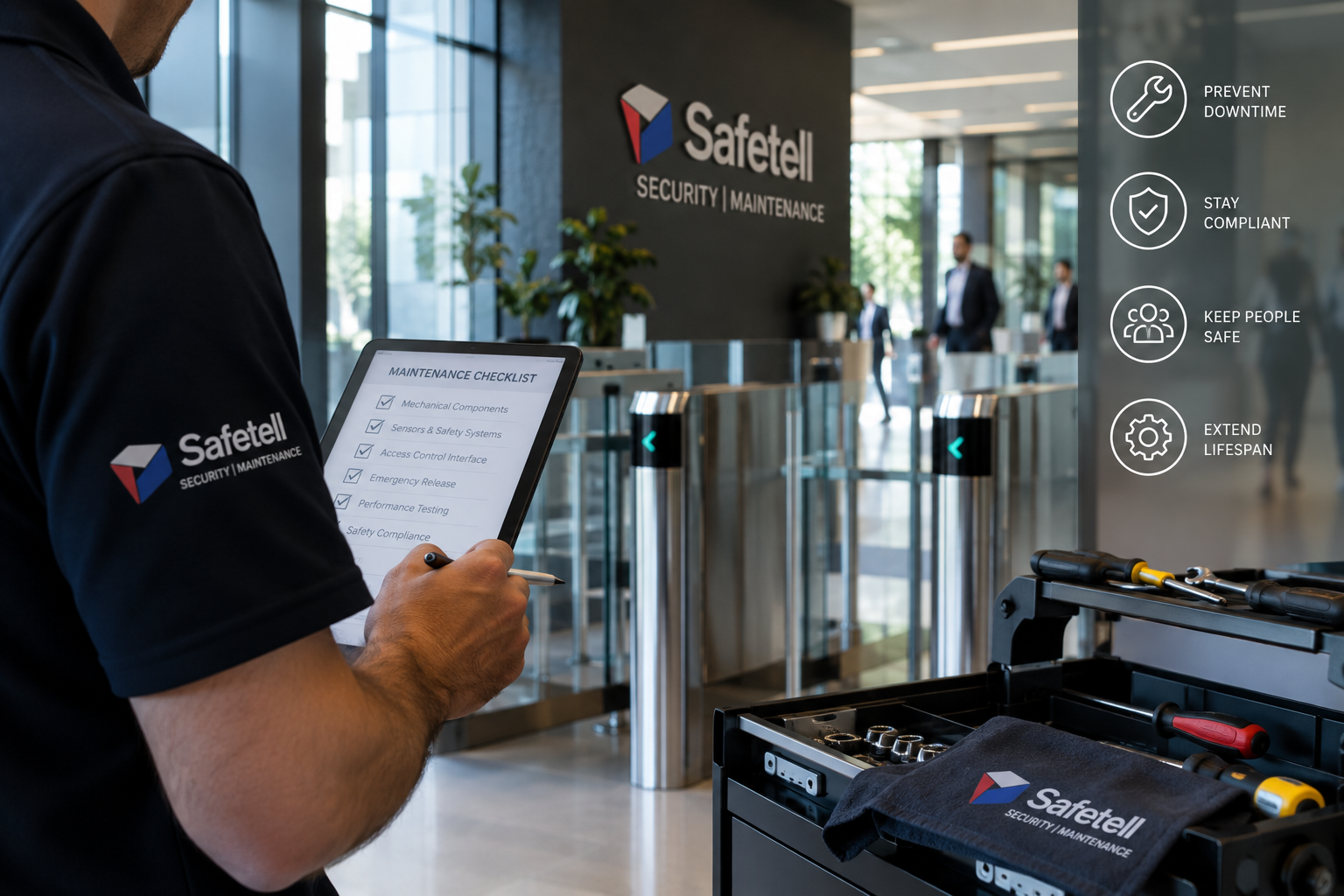
Entrance Control Maintenance Guide for UK Buildings
27 October, 2026
About This Article
This guide is for facilities managers, security managers and estates teams responsible for entrance control systems in UK commercial and public sector buildings. It explains why planned maintenance matters, the relevant UK regulations and standards, typical service intervals, what a maintenance visit includes, common faults, and what to consider when choosing a maintenance partner.
Entrance control systems in UK commercial buildings require regular, planned servicing to remain safe, compliant, and operationally reliable. Speed gates, turnstiles, security portals, and automated doors are all subject to wear, and without scheduled inspections, the risk of unplanned downtime, safety incidents, and non-compliance increases considerably.
This guide covers everything you need to know about entrance control system maintenance for commercial properties across the UK. From regulatory requirements and recommended service intervals to step-by-step inspection processes, you will find practical guidance designed for facilities managers and security managers responsible for keeping buildings safe and accessible.
Safetell delivers expert servicing and maintenance for entrance control systems across commercial and public sector buildings nationwide. With more than 35 years of experience in physical security, the company supports organisations with both planned preventative maintenance and responsive repair.
Key Takeaways: Entrance Control Maintenance for UK Buildings
- Entrance control systems need at least one planned preventative maintenance visit per year to meet UK safety standards.
- BS EN 16005 and the Workplace Regulations 1992 require that powered pedestrian doors are maintained in safe working order.
- Preventive servicing reduces unplanned downtime, emergency repair costs, and safety risks for the people using your building.
- Safetell offers contracted and non-contracted maintenance packages tailored to your building type, traffic levels, and operational requirements.
- Keeping documented service records supports regulatory compliance, informs lifecycle planning, and protects your organisation during inspections or incidents.
What Is Entrance Control System Maintenance?
Entrance control system maintenance is the planned inspection, testing, adjustment, and repair of physical security equipment that manages pedestrian access in and out of buildings. This includes speed gates, turnstiles, security portals, revolving doors, and automated sliding or swing doors.
The goal is to identify wear, faults, or safety issues before they cause a failure. A structured maintenance programme keeps your systems operating reliably and helps you meet the legal duty of care to keep equipment safe for everyone who uses your building.
Maintenance covers both the mechanical and electronic components of each system. That means checking drive units, sensors, locking mechanisms, control panels, battery backups, and connected access control interfaces.
Why Is Regular Servicing Important for Entrance Control?
Entrance control equipment operates in high-traffic environments. Speed gates in a busy office reception may cycle hundreds of times each day. Automated doors at a hospital entrance operate around the clock. That volume of use accelerates wear on moving parts, sensors, and electronic components.
When maintenance is neglected, faults develop gradually. A sensor that drifts out of alignment may allow tailgating. A worn drive belt can slow gate response times. A failing battery backup leaves the system vulnerable during a power cut.
Regular servicing catches these issues early. It also gives you documented evidence that your equipment is being maintained to the appropriate standard, which is directly relevant if there is ever an incident or a regulatory inspection.
Reducing Unplanned Downtime and Emergency Costs
A failed entrance control system at a main access point can disrupt an entire building. Staff cannot enter or exit securely, visitors queue at reception, and security teams are forced to implement manual workarounds.
Emergency call-outs to fix a broken speed gate or jammed automatic door are typically more expensive than scheduled maintenance visits. By investing in planned preventative servicing, you control costs and avoid the operational disruption that comes with reactive repairs.
Protecting Building Occupants and Visitors
Entrance control systems are classified as machinery under UK law. A malfunctioning automated door can cause injury to building users, particularly those with mobility difficulties, visual impairments, or who use wheelchairs.
Routine maintenance ensures that safety sensors, emergency release mechanisms, and fire alarm interfaces all function as intended. This protects the people who use your building every day and demonstrates your commitment to their wellbeing.
Need advice on entrance control systems?
Our team can talk you through the UK Regulations, standards and general maintenance.
UK Regulations and Standards for Entrance Control Servicing
Several UK regulations and industry standards govern the maintenance of powered pedestrian doors and entrance control systems. Understanding these obligations is essential for any facilities manager or security manager responsible for building compliance.
BS EN 16005 and Safety in Use Requirements
BS EN 16005 is the European standard that sets out safety requirements and test methods for powered pedestrian doorsets. According to the British Standards Institution (BSI), the standard covers sliding, swing, revolving, and folding door types operated electro-mechanically, electro-hydraulically, or pneumatically.
For new installations, BS EN 16005 defines the minimum safety level required. For existing installations, the standard represents best practice. Building owners and occupiers are expected to do what is reasonable and practicable to comply with the latest version, according to guidance from the Automatic Door Suppliers Association (ADSA).
The Workplace (Health, Safety and Welfare) Regulations 1992
Regulation 5 of the Workplace Regulations 1992 requires that workplace equipment, including powered doors and entrance control systems, is maintained in an efficient state, in efficient working order, and in good repair. This creates a legal obligation for employers and building managers to implement a programme of regular maintenance.
PUWER: Provision and Use of Work Equipment Regulations 1998
PUWER reinforces the requirement for maintaining work equipment. Regulation 5 states that employers must ensure work equipment is kept in efficient working order and that maintenance logs are up to date. For speed gates and turnstiles in workplace settings, documented servicing is a legal requirement.
The Supply of Machinery (Safety) Regulations 2008
Powered pedestrian doors and entrance control systems are classified as machinery. Under these regulations, systems brought into service must meet essential health and safety requirements. When significant modifications are made during maintenance, the door may be reclassified as a new machine and must conform to the current BS EN 16005 standard.
How Often Should Entrance Control Systems Be Serviced?
The recommended servicing frequency depends on the type of equipment, the volume of traffic it handles, and the operational environment. However, there are general guidelines that apply across most commercial settings.
Minimum Annual Maintenance Visits
Industry guidance recommends at least one planned preventative maintenance visit per year for most entrance control equipment. This applies to automatic doors, speed gates, turnstiles, security portals, and security doors.
High-traffic installations may need two visits per year. A hospital entrance, transport hub, or large corporate headquarters with hundreds of daily users puts significantly more stress on components than a standard office building.
Occupier Safety Checks Between Service Visits
Between professional maintenance visits, building occupiers should carry out regular visual and functional safety checks. The ADSA recommends that occupiers inspect their powered pedestrian doors frequently to identify any obvious issues, such as unusual noises, slow operation, damaged sensors, or warning signs that have been removed.
These checks do not replace professional servicing, but they help identify problems earlier and reduce the risk of an incident between scheduled maintenance visits.
Factors That Affect Service Frequency
Heavy foot traffic accelerates wear on mechanical components. Exposure to weather, dust, or construction debris can affect sensors and electronic controls. Buildings with vulnerable users, such as hospitals or care facilities, may need more frequent inspection to manage risk.
What Does an Entrance Control Maintenance Visit Include?
A professional maintenance visit follows a structured process designed to assess the condition, safety, and performance of each system. The exact scope varies depending on the equipment type and manufacturer recommendations, but the following elements are typically covered.
Step 1: Visual Inspection of All Components
The engineer begins with a thorough visual inspection. This covers the condition of the door or gate panels, housings, fixings, glazing, and any visible wiring. Signs of physical damage, tampering, or corrosion are recorded.
Step 2: Testing Safety Sensors and Protective Devices
Safety sensors are critical to preventing injury. The engineer tests each sensor using standardised test objects to confirm that the system detects obstructions and responds correctly. This includes testing presence sensors, safety curtains, and any hinge-side protection devices.
Step 3: Checking Emergency Release and Fire Alarm Interfaces
In an emergency, entrance control systems must fail to a safe state. The engineer verifies that emergency release buttons, break-glass call points, and fire alarm interfaces all trigger the correct response, typically unlocking or opening the door to allow evacuation.
Step 4: Inspecting Drive Units and Mechanical Components
The drive unit is the core mechanical component of any automated door or gate. Engineers inspect belts, motors, gearboxes, and bearings for wear. They check that the door opens and closes at the correct speed and force, adjusting settings where necessary.
Step 5: Verifying Power Supply and Battery Backup
A reliable power supply is essential for uninterrupted operation. The engineer tests the mains power connection and checks backup battery health. If a battery is degraded, it is flagged for replacement to prevent failure during a power outage.
Step 6: Testing Access Control Integration
Many entrance control systems are connected to access control platforms, including card readers, biometric scanners, and intercom systems. The engineer verifies that these interfaces are communicating correctly and that credentials are being processed without delay.
Step 7: Completing Electronic Reports and Lifecycle Advice
After the visit, the engineer produces an electronic report detailing all findings, adjustments, and any recommended repairs. This report supports your compliance records and helps you plan future investment. Lifecycle advice highlights components that are approaching end of life so you can budget for replacement before they fail.
Entrance Control Types and Their Specific Maintenance Needs
Different entrance control systems have different maintenance requirements. The equipment in your building determines the scope and focus of each service visit.
Speed Gates and Speed Lanes
Speed gates use optical sensors and motorised barriers to control pedestrian access at high speed. Maintenance focuses on sensor calibration, barrier alignment, motor condition, and anti-tailgating detection accuracy. Safetell installs and maintains speed gates designed for fast, reliable access control with integrated anti-tailgating functionality.
Tripod Turnstiles
Tripod turnstiles have fewer moving parts than speed gates, but the rotation mechanism and locking solenoid still require periodic inspection. Engineers check arm tension, rotation smoothness, and the condition of the tripod mechanism to confirm it is operating without obstruction.
Security Portals and Interlocking Doors
Security portals control single-person access and are used in high-security environments such as data centres and financial institutions. Maintenance involves testing the interlock sequence, verifying detection systems for tailgating and abandoned objects, and inspecting the door panels, locking mechanisms, and glazing.
Automatic Sliding and Swing Doors
Automatic doors are among the most common entrance control systems in commercial buildings. They require regular checks on the drive operator, guide rails, hanging gear, safety sensors, and closing force. The door must meet the safety requirements of BS EN 16005, and each maintenance visit should confirm compliance.
Revolving Doors
Revolving doors have a more complex mechanical assembly than standard sliding or swing doors. Maintenance includes inspecting the rotation drive, speed regulation, safety sensors on each wing, and the emergency breakout mechanism. The revolving door must be able to collapse or stop safely in an evacuation scenario.
How to Build a Maintenance Schedule for Your Building
Creating a structured maintenance schedule ensures that no system is overlooked and that servicing is carried out at the right frequency for your specific operational needs.
Step 1: Audit Your Entrance Control Assets
Start by creating a register of every entrance control system in your building or estate. Record the equipment type, manufacturer, model, installation date, and location. This asset register forms the foundation of your maintenance programme.
Step 2: Assess Traffic Volume and Risk Profile
For each system, assess the volume of daily traffic and the risk profile of the location. A main entrance used by staff, visitors, and delivery personnel will need more frequent attention than a side door used only by authorised personnel.
Step 3: Determine Service Intervals
Based on your asset audit and risk assessment, assign a service interval to each system. The minimum recommendation is one planned visit per year. High-traffic or high-risk installations should be scheduled for two visits per year.
Step 4: Choose a Maintenance Partner
Select a maintenance partner with experience across the range of entrance control systems in your building. A system-agnostic partner can service equipment from multiple manufacturers, giving you independent advice on condition and lifecycle planning.
Safetell supports both contracted and non-contracted maintenance arrangements, covering automatic doors, speed lanes, turnstiles, security doors, revolving doors, and shutters.
Step 5: Implement Occupier Safety Checks
Train your facilities or security team to carry out regular occupier safety checks between professional service visits. Document these checks and report any concerns to your maintenance partner promptly.
Common Entrance Control Faults and How Maintenance Prevents Them
Understanding the most common faults helps you appreciate why preventive maintenance is worth the investment.
Sensor Misalignment or Failure
Sensors can drift out of calibration over time, especially in environments with changing light conditions, dust, or temperature fluctuations. Misaligned sensors may fail to detect obstructions, creating a safety hazard. Regular calibration during maintenance prevents this.
Drive Unit Wear
Motors, belts, and gearboxes in automatic doors and speed gates are subject to mechanical wear. A worn belt can cause slow or inconsistent door movement. Scheduled inspection identifies wear before a component fails completely.
Battery Degradation
Backup batteries lose capacity over time. If a battery has degraded significantly, the system may not operate during a power cut. Maintenance visits include battery health checks and recommendations for timely replacement.
Software and Firmware Issues
Entrance control systems increasingly rely on software for access management, logging, and integration with building management systems. Outdated firmware can cause communication errors or security vulnerabilities. Maintenance should include a software review to confirm that systems are running current versions.
How a Repair-Not-Replace Approach Saves You Money
Not every fault requires a full component replacement. An experienced engineer can often diagnose and repair a problem, extending the life of the existing equipment and reducing your costs.
Safetell follows a repair-not-replace philosophy for entrance control maintenance. Where a safe and dependable repair remains practical, the team retains existing equipment rather than recommending unnecessary replacements. Because Safetell is not tied to a single equipment manufacturer, the advice is independent and based on what is genuinely required.
This approach is particularly valuable for organisations managing large estates with multiple entrance systems. Repairing rather than replacing keeps lifecycle costs down and avoids the disruption of full system changeovers.
Choosing the Right Maintenance Partner for Your Building
The quality of your maintenance programme depends on the expertise and reliability of the partner you choose. There are several factors to consider.
Industry Accreditation and Engineer Qualifications
Look for a maintenance partner that is an ADSA-approved service partner with engineers trained to the BS EN 16005 standard. Directly employed, BS 7858 security-vetted engineers give you confidence that the people working on your premises are qualified and trustworthy.
System-Agnostic Capability
A partner who can maintain equipment from a range of manufacturers gives you unbiased advice. You avoid being steered toward replacement products from a single supplier when a repair would serve you just as well.
Nationwide Coverage and Multi-Site Support
If you manage multiple buildings, a partner with nationwide coverage simplifies coordination. A single point of contact for all your sites reduces administrative burden and ensures consistent service quality across your estate.
Flexible Contract Options
Every organisation has different requirements. Some prefer a contracted planned maintenance programme with pre-agreed response times and discounted parts. Others need the flexibility of non-contracted, purchase-order-based support. The right partner offers both options.
In Conclusion: Keeping Your Entrance Control Systems Safe and Compliant
Maintaining entrance control systems in UK commercial buildings is a legal obligation, a safety imperative, and a sound financial decision. Regular planned servicing keeps speed gates, turnstiles, security portals, and automated doors operating reliably, protecting both the people who use your building and your organisation’s compliance position.
A structured maintenance programme, supported by occupier safety checks between professional visits, gives you control over costs and reduces the risk of unplanned disruption. Documented service records support your compliance with BS EN 16005, the Workplace Regulations, and PUWER.
If you are responsible for entrance control systems in a UK commercial building, Safetell can help you build a maintenance programme tailored to your specific requirements. Get in touch directly to discuss your needs.
Need Support With Entrance Control Maintenance?
Safetell provides planned preventative maintenance and responsive repairs for speed gates, turnstiles, automatic doors and other entrance control systems across the UK.
FAQs About Entrance Control Maintenance
How often should entrance control systems be serviced?
Most entrance control systems should be professionally serviced at least once a year. High-traffic installations, such as busy office entrances, hospitals and transport environments, may require two maintenance visits per year depending on usage, equipment type and risk.
Is entrance control maintenance a legal requirement in the UK?
UK legislation requires workplace equipment to be maintained in a safe and efficient condition. The Workplace (Health, Safety and Welfare) Regulations 1992 and PUWER 1998 place responsibilities on employers and building managers to ensure equipment such as powered doors and entrance control systems remains safe and in good working order.
What does an entrance control maintenance visit include?
A maintenance visit typically includes a visual inspection, safety sensor testing, emergency release checks, inspection of motors and mechanical components, power supply and battery checks, access control integration testing and an assessment of the overall condition of the system. An electronic service report should also record any faults, adjustments or recommended repairs.
Which entrance control systems require regular maintenance?
Regular maintenance can apply to speed gates, speed lanes, turnstiles, security portals, revolving doors and automatic sliding or swing doors. Each type of entrance system has different mechanical, electronic and safety components that need to be inspected and tested.
What is BS EN 16005 and why is it important?
BS EN 16005 sets out safety requirements and test methods for powered pedestrian doorsets, including sliding, swing, revolving and folding doors. It defines safety requirements for new installations and provides recognised best-practice guidance for existing powered pedestrian doors.
What are the signs that an entrance control system needs maintenance?
Warning signs can include unusual noises, slower operation, inconsistent opening or closing, sensor problems, intermittent faults or changes in the way the system responds to users. Identifying these issues early can help prevent a minor fault developing into an unexpected system failure.
Should safety checks be carried out between professional service visits?
Yes. Building occupiers should carry out regular visual and functional checks between professional maintenance visits. This can help identify obvious issues such as unusual noises, damaged components, slow operation or sensor problems before they become more serious.
Can regular servicing reduce entrance control downtime?
Planned preventative maintenance can help identify worn components, sensor issues, battery degradation and mechanical problems before they cause a complete failure. This can reduce unplanned downtime, operational disruption and the need for emergency repairs.
Can Safetell maintain entrance control systems installed by another company?
Yes. Safetell maintains entrance control equipment from a range of manufacturers. This system-agnostic approach allows existing equipment to be assessed based on its condition, safety and performance rather than automatically recommending replacement with a particular manufacturer’s system.
Does Safetell offer entrance control maintenance without a long-term contract?
Yes. Safetell offers both contracted planned maintenance and non-contracted support. This gives organisations the option to arrange maintenance and repairs according to their operational requirements without necessarily committing to a long-term service contract.
Can entrance control equipment be repaired instead of replaced?
In many cases, yes. Where a safe and dependable repair is practical, existing equipment can often be retained rather than completely replaced. A repair-not-replace approach can extend equipment life, reduce lifecycle costs and minimise disruption to the building.